
Key Insights
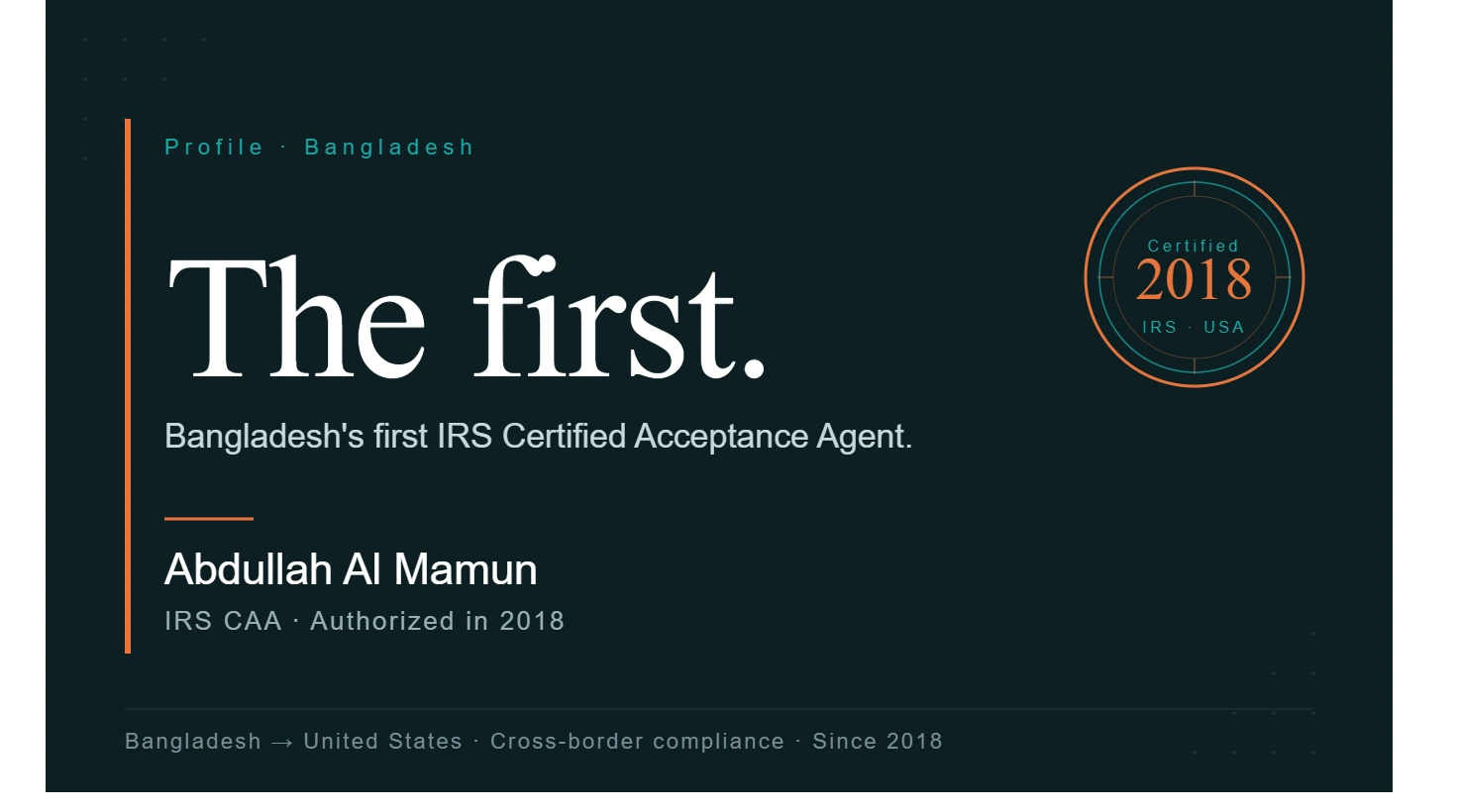
- Abdullah Al Mamun became Bangladesh’s first IRS Certified Acceptance Agent in 2018.
- His CAA role created a local point of IRS-facing support for Bangladeshi applicants dealing with U.S. tax documentation.
- A Certified Acceptance Agent helps eligible foreign applicants with ITIN-related document review, Form W-7 preparation, and IRS process accuracy.
- A CAA is different from a registered agent. One works with IRS documentation, while the other handles state notices for a company.
- More Bangladeshi founders are forming U.S. companies to work with global clients, access better payment options, and build trust.
- U.S. business setup is not one document. Company formation, EIN, banking, payment gateways, tax filing, and ITIN support often connect.
- Many founders focus on the wrong document first, while the real issue may sit earlier in the setup chain.
- Business Globalizer supports the wider founder journey through company formation, EIN, ITIN, registered agent, business address, BOI filing, banking, tax filing, and merchant account services.
Global business sounds exciting until the paperwork shows up.
For Bangladeshi founders working with U.S. companies, that paperwork often means EIN, ITIN, Form W-7, tax filing, banking checks, or payment gateway verification.
One day you form a U.S. company, receive international payments, or work with U.S. clients. The next day you are staring at IRS forms, tax identification numbers, and compliance requirements that nobody around you fully understands. For years, many founders had to rely on secondhand advice, online forums, or overseas contacts to understand what the IRS actually required.
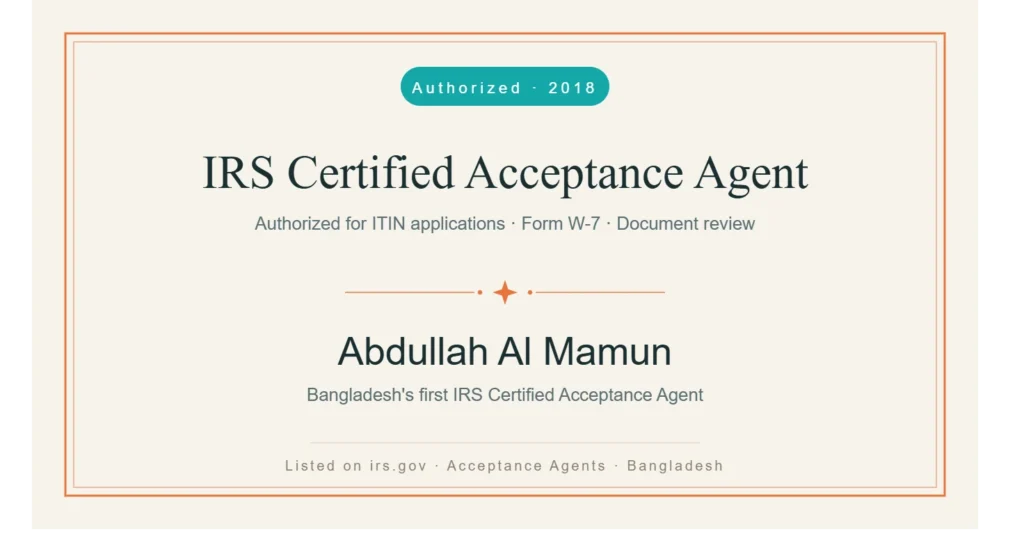
That began to change in 2018, when Abdullah Al Mamun became Bangladesh’s first IRS Certified Acceptance Agent. This position matters because IRS CAA status is not a marketing label; it is an IRS-recognized authorization tied to ITIN application support and document review responsibilities.
His certification helped close the gap by creating a local point of structured, IRS-facing support for applicants who needed the process explained and prepared properly.
What an IRS Certified Acceptance Agent Actually Does
Most people outside tax and compliance work have never heard of a CAA. So let’s go through what a CAA actually is.
An IRS Certified Acceptance Agent is authorized by the IRS to help eligible foreign applicants apply for an ITIN, or Individual Taxpayer Identification Number. The role covers document review, identity checks, tax-purpose review, and proper Form W-7 preparation.
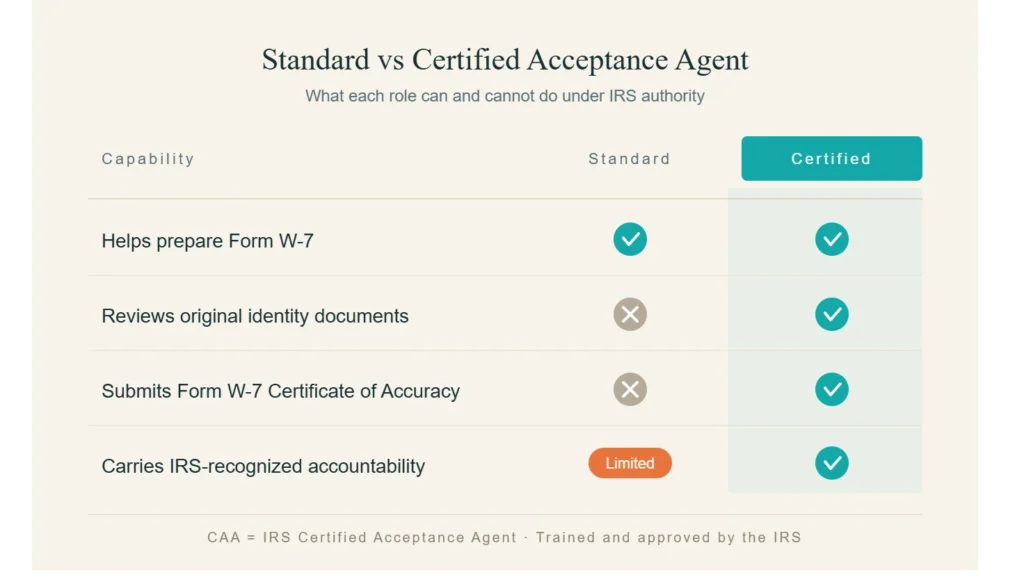
The “Certified” part matters because a CAA has more responsibility than a standard Acceptance Agent.
| Role | Standard Acceptance Agent | Certified Acceptance Agent |
| Helps prepare Form W-7 | Yes | Yes |
| Reviews original identity documents | No | Yes |
| Submits Form W-7 Certificate of Accuracy | No | Yes |
| Carries IRS-recognized accountability | Limited | Yes |
A CAA is not just a form preparer. They act as an IRS-recognized support point before the application reaches the IRS. That is why the credential carries weight. It requires IRS training, approval, and ongoing compliance.
Why More Bangladeshi Founders Started Looking at U.S. Companies
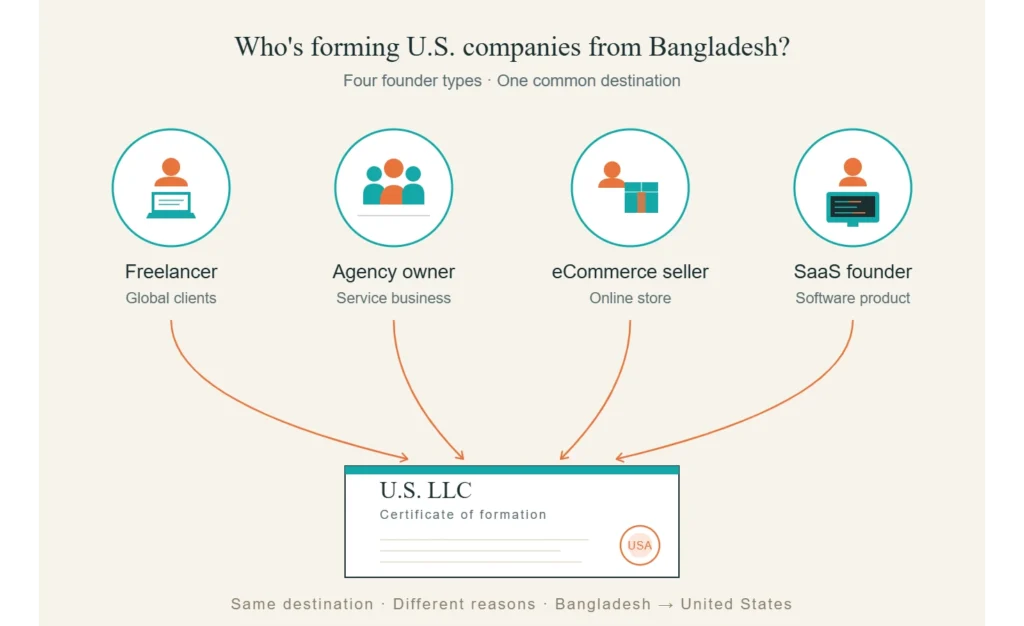
Over the last several years, more Bangladeshi founders have started seeing U.S. companies as practical business tools. Freelancers, agency owners, eCommerce sellers, SaaS founders, and consultants use them to work with global clients, access better payment systems, build trust, and operate in a larger market. For many of them, the U.S. company is not just about prestige; it is tied to payments, contracts, tax records, client trust, and platform access.
But the interest grew faster than the support system around it.
Many could form a U.S. LLC or apply for an EIN, but the deeper IRS documentation side stayed unclear. ITIN, tax filing, identity documents, payment gateway checks, and non-resident compliance often came later.
The Role of Abdullah Al Mamun in This Shift
Being the first CAA in Bangladesh was not just a credential. It meant stepping into a space where founder demand was growing faster than proper IRS-facing support.
Bangladeshi founders were forming U.S. companies, applying for EINs, opening bank accounts, and preparing for payment gateways. But when IRS documentation became part of the process, there was no local framework to follow.
- No documented patterns.
- No tested local process.
- No clear link between IRS paperwork and U.S. business setup from Bangladesh.
So the process had to be built through real cases, repeated filings, document reviews, and founder-specific problems that could not be solved from theory alone.
That process, repeated over seven years, built something a certification alone cannot give.
How This Helps Bangladeshi Entrepreneurs Building Globally
Bangladesh’s cross-border business landscape looks very different in 2026 than it did in 2018. Before, the idea of a Bangladeshi founder running a U.S. LLC was still uncommon. Today the picture is completely different:
- Founders all over the country are forming U.S. companies.
- Local freelancers are serving U.S. clients.
- eCommerce sellers are operating globally.
- SaaS founders are building from Bangladesh and selling worldwide.
That growth created a wave of IRS-related documentation needs most founders were completely unprepared for.
Seven years of working through those needs, case by case, built a depth of Bangladesh-specific understanding that is difficult to replicate quickly. That covers:
- How Bangladeshi documentation maps to U.S. banking verification requirements.
- Which payment gateways create the most friction for Bangladeshi non-residents.
- What IRS edge cases come up most often in this specific founder population.
- How to structure a documentation package that holds up across company formation, banking, tax filing, and payment systems.
That knowledge does not come from a training manual. It comes from years of real cases with real founders in this specific market.
The Documentation Chain Most Founders Misunderstand
One thing seven years of practice builds is pattern recognition. You start seeing the same problem beneath different cases: founders are often trying to fix the right issue in the wrong order.
For a Bangladeshi non-resident founder, the setup usually works like a chain:
Company formation → EIN acquisition → Banking preparation → Payment gateway setup → Tax compliance → ITIN support
(The order can change depending on the case, especially when tax filing or ITIN requirements appear earlier, but the main point stays the same: one weak document can affect the next step.)
Each step affects the next. When one part is weak, the problem can show up in another.
- Weak formation documents can create banking problems.
- An incorrectly obtained EIN can delay payment gateway review.
- Tax documents prepared out of order can make the business profile look inconsistent.
- An ITIN application without a valid federal tax purpose can be rejected.
Most founders come in focused on one document. But often, the real issue sits two steps behind it. That is where experienced support matters. It helps identify what needs fixing first, what can wait, and whether an ITIN is actually required at all.
Abdullah Al Mamun’s Role at Business Globalizer
At Business Globalizer, Abdullah Al Mamun’s role connects certified IRS support with the wider business setup non-resident founders often need.
A founder may come for ITIN support, but the actual need may also involve company formation, EIN, tax filing, or payment setup. His role is to understand and guide where the IRS documentation fits inside that full picture. That matters because a founder may think they only need one form, while the real issue may involve structure, tax purpose, ownership documents, or banking consistency.
Business Globalizer can support that wider setup through:
- U.S. Company Formation
- EIN Service
- ITIN Service
- Registered Agent
- Business Address
- BOI/FinCEN compliance review where applicable under current rules
- Fintech Bank Account Support
- U.S. Tax Filing
- Merchant Account Support
- Premium Business Consulting
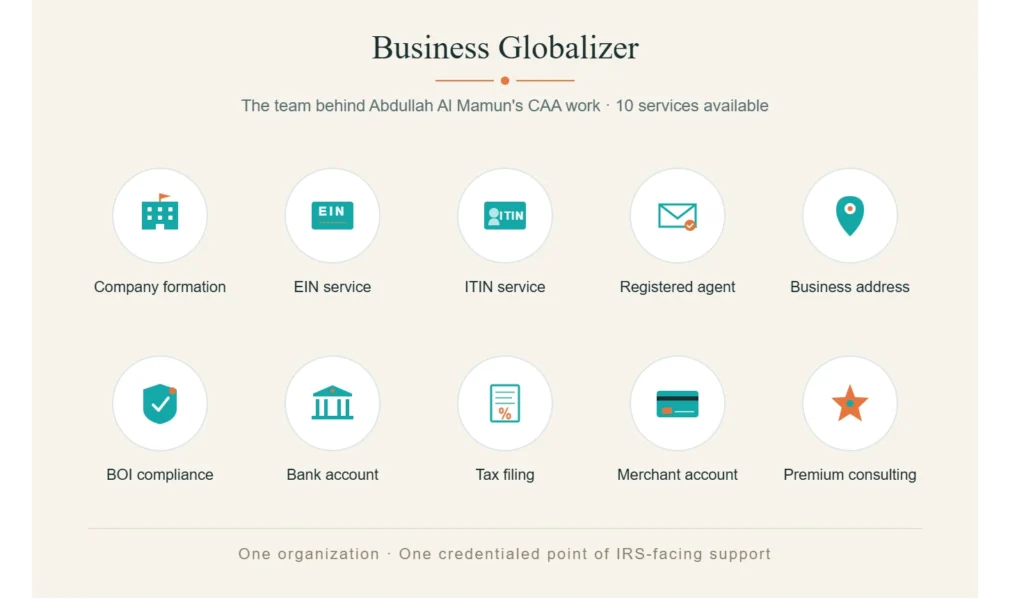
The services at BG make the support more complete than one form or one document. It connects Abdullah Al Mamun’s CAA role with the practical services founders need to build and maintain a U.S.-linked business.
Final Thoughts
If your business connects with the U.S. through taxes, banking, payments, or company ownership, the documents need to be right. Not close enough. Right. Banks, payment processors, tax systems, and platforms are asking harder questions now, and weak paperwork does not travel far.
That is why Abdullah Al Mamun’s role matters. His IRS certification, years of experience, and Bangladesh-specific context give founders a stronger place to start. Building beyond borders starts with ambition. The right documentation and structure help that ambition move forward with confidence.
FAQs on Bangladesh’s First IRS Certified Acceptance Agent
What is an IRS Certified Acceptance Agent?
An IRS Certified Acceptance Agent, or CAA, is authorized by the IRS to help eligible foreign applicants with ITIN applications. The role includes reviewing documents, checking application details, and helping prepare Form W-7 properly.
Is a CAA the same as a tax preparer?
No. A CAA helps with ITIN-related document review and Form W-7 support. Tax preparation is a separate service, though both may connect in some filing situations.
Can a CAA guarantee ITIN approval?
No. The IRS makes the final decision on every ITIN application. A CAA can help prepare the file properly, but approval is never something anyone should guarantee.
When should someone apply for an ITIN?
Someone from Bangladesh should apply for an ITIN when there is a valid U.S. federal tax purpose. It is better to confirm the reason first instead of applying simply because someone online suggested it.
Does a Bangladeshi applicant need to send original documents to the IRS?
It depends on the case and the document route used. Many applicants prefer CAA support because it can reduce the need to send certain original documents directly to the IRS.
Is ITIN required for Bangladeshi owners of single-member LLCs?
Not automatically. A Bangladeshi owner may need ITIN depending on the LLC’s tax reporting, income situation, and filing requirements.
Who is Abdullah Al Mamun?
Abdullah Al Mamun is Bangladesh’s first IRS Certified Acceptance Agent, certified in 2018. His work focuses on helping Bangladeshi and global founders handle ITIN-related documentation, U.S. tax identification needs, and IRS-facing support more properly.
Why does Abdullah Al Mamun’s CAA role matter for Bangladeshi founders?
It matters because Bangladeshi founders often deal with U.S. company formation, EIN, banking, tax filing, and ITIN questions without enough local IRS-facing guidance. His CAA role gives them a more structured point of support from Bangladesh.
